
The difference between Photojournalism/76 photographers and those in the 2026 Best of Photojournalism is bigger than the shift from black and white to color. The deeper change appears in the names themselves.
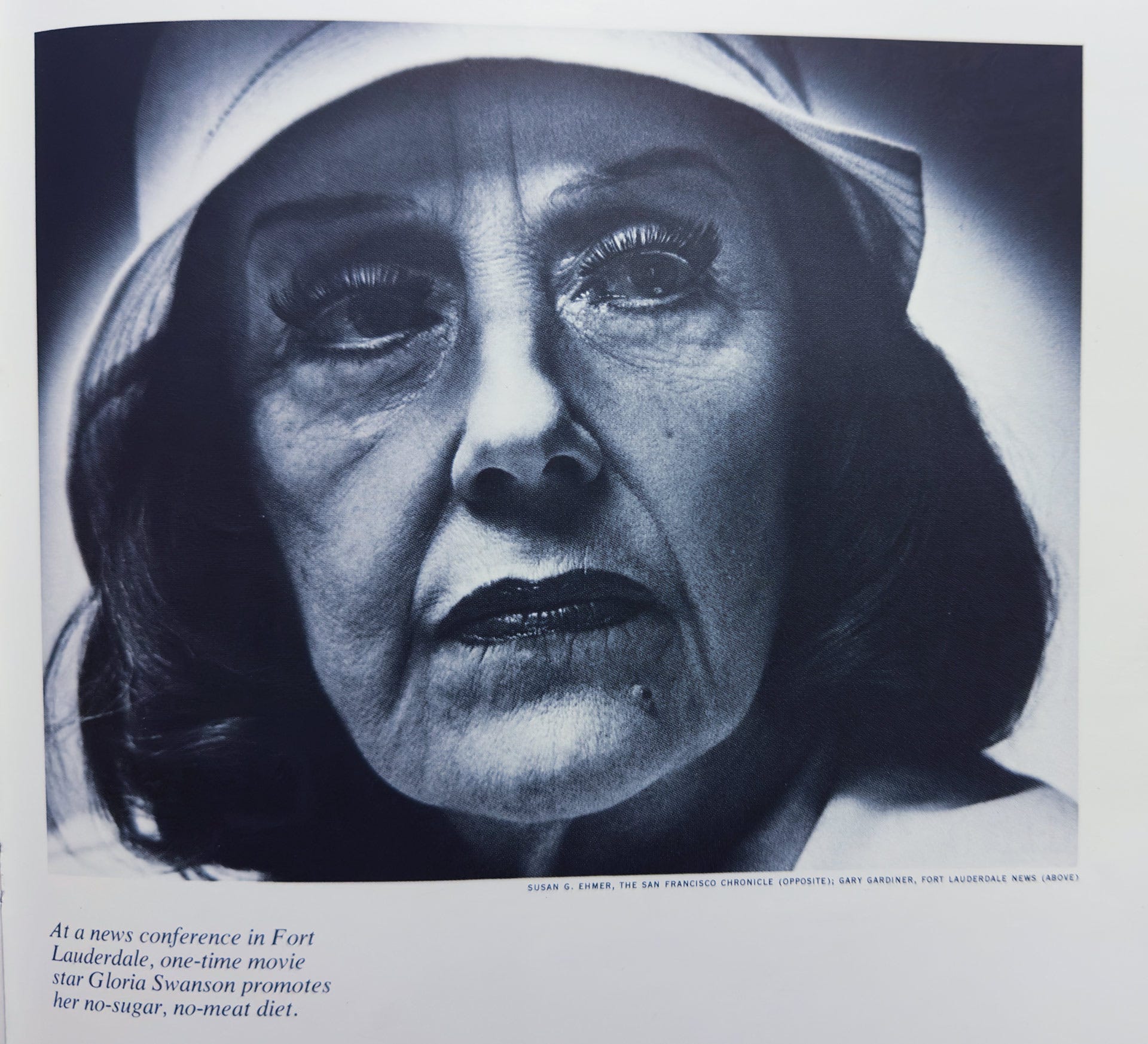
In 1976, I photographed Gloria Swanson while working as a staff photographer for the Fort Lauderdale News. Like most assignments in a daily newspaper newsroom, it began and ended quickly. Film went into the camera. The shutter clicked. The rolls went back to the office, where the film was developed, prints were made, and the photographs were sent upstairs to the composing room for the next day’s paper.
Months later, my photo resurfaced in a different context. It had been selected for the annual Pictures of the Year competition, the profession’s long-running showcase of the best work produced by newspaper photographers. Eventually, it appeared in the printed volume Photojournalism/76, among the photographs judged to represent the year’s best work in American photojournalism.
Looking through that book today reveals more than a collection of strong photographs. It reveals the profession’s structure as it existed at the time.
The photographers listed worked for newspapers throughout the United States, their affiliations reflecting a map of the regional press: Akron Beacon Journal, Milwaukee Journal, Kansas City Star, Charlotte Observer, Dayton Daily News. These local and regional publications documented community life, each paper reflecting its community’s photographic voice.
Most photographers were staff members. Their assignments followed the rhythm of local journalism: city council in the morning, school events in the afternoon, basketball games at night. Photojournalism/76 features Skip Peterson’s photo of a young evangelist praying with a believer, Stanley Forman’s Pulitzer-winning image of a mother and daughter on a collapsing fire escape, Jay Dickman’s solemn photo of a police officer’s funeral, and Jerry Gay’s lively scene of a couple kissing while a businessman looks on—all capturing the ordinary and extraordinary moments that filled American newspapers.
Those photographs reached their readers through the newspapers that employed the photographers who made them. When images moved beyond their local markets, they traveled through a distribution system that now feels almost mechanical.
Distribution beyond the local readership depended on the Associated Press photo network.
When I arrived in Columbus, Ohio, in 1982, that system was still operating much as it had for decades. Columbus was one of the largest Associated Press newspaper membership centers in the country. Photographers across Ohio contributed substantially to the AP report with stories and photographs. Yet the infrastructure that carried those photos was surprisingly limited.
There were only seven photo transmitters in the entire state.
Most transmitters were in newspaper photo departments and connected by AT&T's leased network to the AP control bureau in Chicago, which managed traffic. Sending a single photograph took about ten minutes.
During those ten minutes, the transmitter was occupied. Every other image had to wait its turn. Editors had to decide whether a photograph justified tying up the machine.
The network worked, but it worked deliberately. Because transmission capacity was limited, most photographs appearing in American newspapers were produced locally by the photographers who worked there, and only a small number traveled beyond their original markets. The limits of that system shaped not only how photographs traveled, but also whose photographs were likely to be seen beyond their own communities.
Changing Priorities
One of the most talented photographers in Ohio during those years worked far from an AP transmitter.
The New Philadelphia Times-Reporter served a small city in eastern Ohio along a north–south highway. It was not a place where dramatic breaking news captured statewide attention. Assignments were familiar to anyone at a community newspaper: high school sports, county fairs, church festivals, parades, and other small-town rituals.
Yet the photographer working there had an extraordinary eye. He could turn ordinary moments into compelling visual stories. A wrestling match in a crowded gymnasium and children running through a carnival midway could transform into an image full of light and movement. Scenes that might seem routine to others became photographs that made editors pause.
I knew these photos deserved a wider audience. The challenge was not the photography. The challenge was the network.
New Philadelphia had no Associated Press photo transmitter. The nearest bureau was in Columbus. If the photographer wanted his work to reach newspapers beyond his town, the prints had to be physically shipped.
So the photographs went on a Greyhound bus.
An envelope containing the prints would be placed on a bus headed toward Columbus. When it arrived at the downtown station, someone from the AP bureau would walk two blocks to pick up the package. The prints were captioned and finally placed on the transmitter. Only then could the photographs begin their ten-minute journey across the wirephoto network.
By the time those images appeared in other newspapers, they were often two days old. Sometimes older, depending on when they were first published locally.
Today, that delay feels unimaginable. At the time, it was simply how the system worked.
Eventually, the system adapted. A transmitter was reassigned to the New Philadelphia newspaper from another Associated Press member’s paper that had stopped contributing photographs to the report. Moving the machine required approvals from several levels of AP management, along with coordination across the technical and telecommunications infrastructure supporting the network.
Once the machine was installed, photographs from New Philadelphia could finally move directly and quickly onto the statewide wire.
The decision proved wise, though the outcome was not exactly what anyone expected. The photographer whose work had prompted the change was soon hired away by a much larger metropolitan newspaper after editors there recognized the quality of his work. In the years that followed, he was named Photographer of the Year several times before eventually retiring from that larger paper.
Transitioning To Color
Technology shaped not only how photographs traveled, but also how they appeared in print. Most photographs moving through the Associated Press were black and white, as color photography, though available, was used sparingly. Printing color required adjustments in the pressroom for ink registration and reproduction, so newspapers scheduled color pages only on certain days when presses were configured accordingly.
Black-and-white film fit the rhythm of the newsroom. It could be developed quickly in the darkroom. Prints could be made and transmitted with relatively little delay.
Color was another matter.
Before digital transmission, delivering a color photograph required sending three separate images. A color print was mounted on the transmitter. A scanning head moved across the photograph while colored filters separated the image into its components.
First cyan, then magenta, then yellow. Each pass required about ten minutes. A single color photograph, therefore, occupied the transmitter for roughly thirty minutes before receiving newspapers could reconstruct the image for printing.
Editors had to decide whether the photograph justified tying up the machine for half an hour.
Change began with the launch of USA Today in 1982 and its daily color photographs. The deeper shift came in the mid-1990s, when the AP’s Photostream electronic darkroom allowed photographs to be scanned, captioned, and transmitted digitally. At the same time, digital cameras entered newsrooms.
Once photos could be captured electronically and transmitted by computer, decades-old barriers fell. Color photography quickly became standard.
But the most important change was not color.
A Wider World in the Winners List
Open the Photojournalism/76 book, and most of the photographers come from American newspapers. Their affiliations read like a map of the country’s regional press: the Akron Beacon Journal, the Milwaukee Journal, the Kansas City Star, the Charlotte Observer, the Dayton Daily News. The names reflect the same geography. The photographers were embedded in communities across the United States, documenting the events and rhythms of local life.
A few photographers in the 1976 contest were affiliated with organizations that operated beyond the boundaries of local newspapers, including international wire services and magazines such as National Geographic. But even those contributors were often American photographers whose careers had begun in the same newspaper system as their colleagues.
Fifty years later, the winners’ list tells a very different story.
The 2026 Best of Photojournalism contest is published electronically and distributed instantly across the internet. The photographers represented there come from many parts of the world. Their names reflect a wider range of languages, cultures, and backgrounds. Their affiliations include international wire services, global news organizations, and independent photographers whose work travels through digital networks.
Exceptional photographers have always existed in many places, but the systems that distributed their work were once narrow and slow. As those technological barriers disappeared, photographers working far beyond the traditional American newspaper system gained ways to bring their work to editors, audiences, and contests that they would never have seen.
The result is a broader view of the world, shaped by photographers bringing their own experiences and perspectives to the stories they document. It is a view assembled from many more places, many more cultures, and many more lives than the old newspaper network could ever show.
The camera remains the same instrument it was fifty years ago. What has changed is that more photographers can now use it to show the world to the rest of us.

My Final Photo News is a reader-supported publication. To receive new posts and support my photography and commentary, become a free or paid subscriber. Subscribe to The Westerville News and PhotoCamp Daily.