
I’ve come to think that the photographs I care about most are made in the second act.
In screenwriting, the second act is the unsettled middle, where the story finds its shape through uncertainty. Things shift, fall away, and transform. A person moves through the world not fully knowing what’s being asked of them. The first act gives an entrance, the third an ending. The second act is where you’re tested, following something before you can explain it, and discovery happens.
That is where photography lives for me, too.
Looking at a photograph, people see a finished thing: a frame, a choice, a piece of the world held still. The image can seem composed and conclusive, as if I knew exactly what to do. But that’s almost never how it feels. Photography feels less like an answer and more like moving toward something sensed but unnamed.
Most of the time, I begin with almost nothing. A walk. A corner. Weather. The way light catches a wall, or doesn’t. A figure in the distance. A color that pulls the rest of the street into relation. I look, then look again. I slow down. I wait. Sometimes I keep walking and then stop because some part of me has understood something a second before the rest of me has. I turn back. I stand there longer than I meant to. I try to understand what I’m being asked to notice.
That, to me, is the beginning of the picture.
Not certainty. Not mastery. Not a plan unfolding neatly. More often, it is a low-grade suspense. Something is there, but it hasn’t declared itself. The photograph begins as a pressure in my attention, a slight quickening, a sense that the ordinary surface of things has shifted and that if I stay with it, something may open.
Sometimes things open; sometimes they remain closed. Either way, the process reveals something important.
That matters too. The second act is not where everything works. It is where you remain inside the possibility that something might.
The language of photography often feels wrong to me when it focuses only on resolution. We talk about the captured moment or decisive instant, and that can be true. But those phrases make the act sound cleaner than it is. They skip the drift, missed chances, uncertainty, and the feeling of being led by a scene not yet understood—the time spent hovering near an image before it forms.
When I’m out photographing, I am not collecting conclusions. I am moving through unfinished moments.
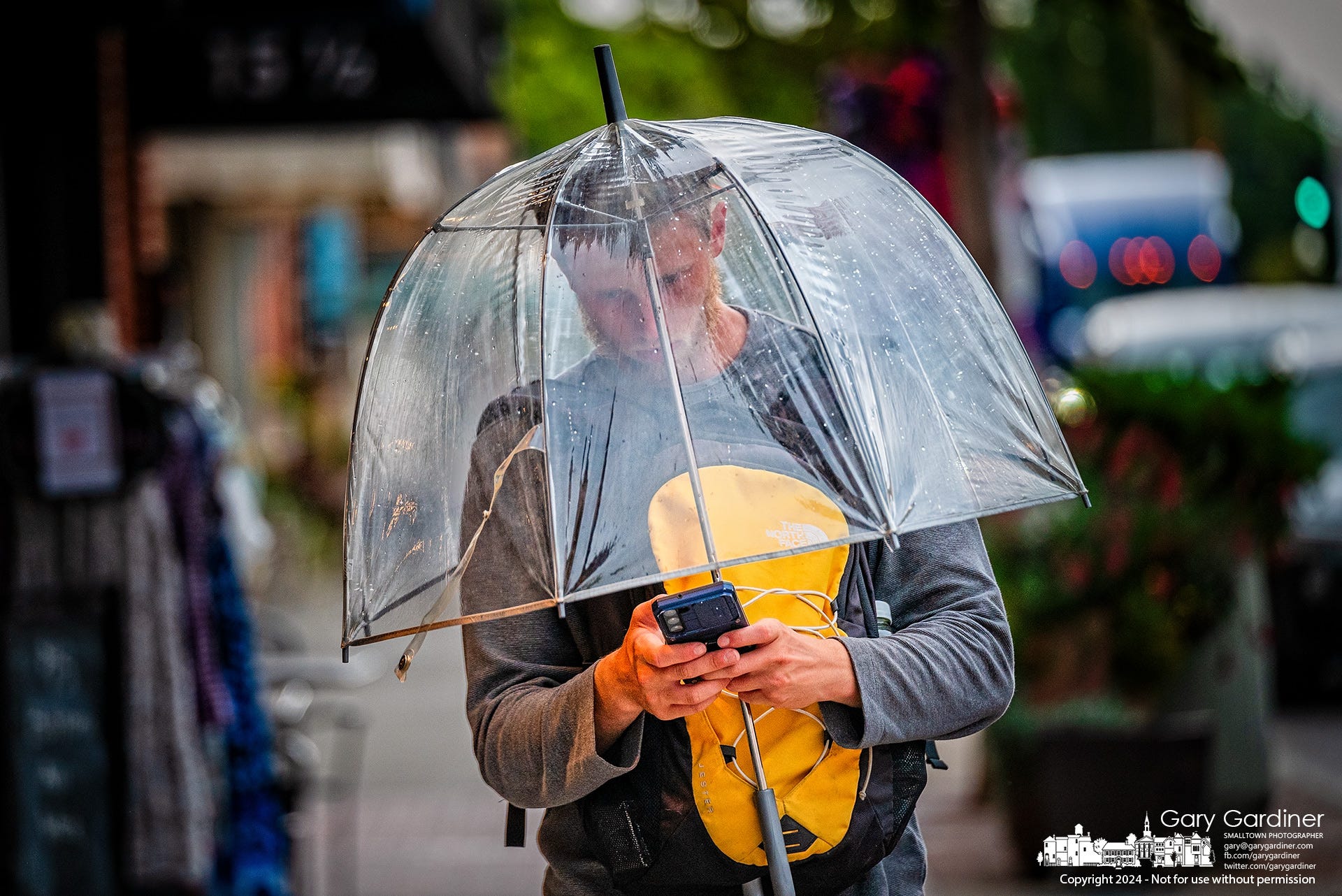
A man standing under a clear umbrella in the rain, lit by the pale glow of his phone, does not present itself to me as an explanation of modern life, loneliness, or distraction. It begins more quietly than that. First, there is the odd beauty of the umbrella itself, how it both hides and reveals. Then the way the rain turns visible on its surface. Then the isolation of the figure inside it, carrying his own weather and his own light. Everything outside him softens into blur, and for a second, the whole scene feels both public and private, exposed and sealed off. I do not think these things in words all at once. I feel them gather. The picture emerges from that gathering.
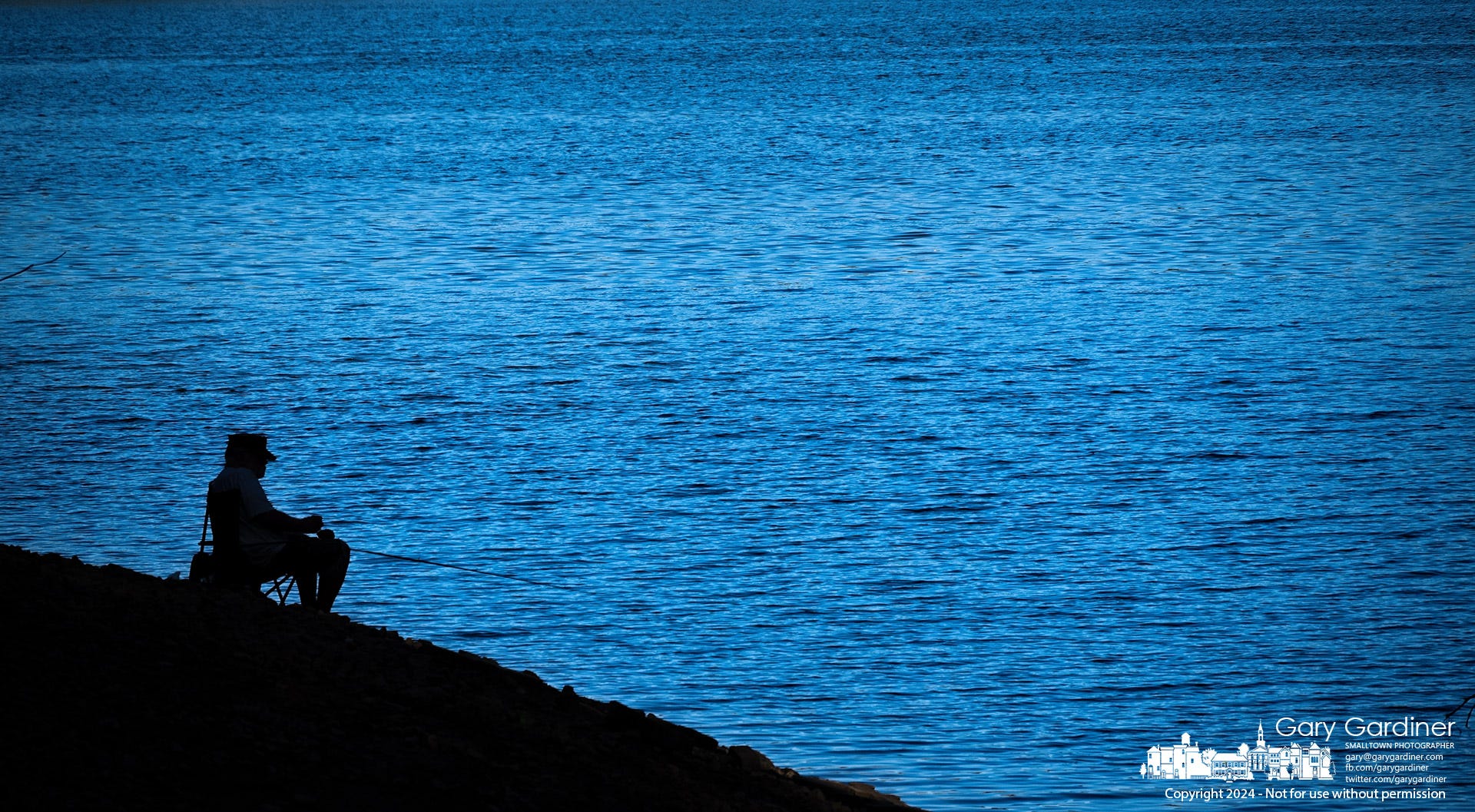
Or a fisherman sits in silhouette against a body of blue water. Seen later, it can look peaceful, nearly absolute in its simplicity. But what I remember is not peace. I remember the distance, the waiting, the strange balance between solitude and activity, between the man’s stillness and the movement implied beyond him. The picture did not seem meaningful. It became meaningful by degrees. It was as if the scene had to keep lowering its voice before I could hear what was there.
That is the kind of experience I trust, and it shapes how I approach my work.
Not because it is vague, but because it is alive. It allows the photograph to remain discovered rather than imposed. It lets the world have some say in the image.
I’ve learned that arriving with too fixed an idea of the photograph flattens the experience before it can become anything. The frame may be competent or strong, but it can already feel closed and resolved. The photographs that stay with me usually interrupt me and require me to adjust my understanding. They do not confirm what I already know—they show me where I have not fully looked.
That’s why I return to the second act. It names the emotional state in which photographs that matter to me are made: before interpretation, before statements or themes, in the middle of attention—still following, still susceptible, still trying to recognize the shape of something as it emerges.
The third act comes later, marking a shift in who interprets the photograph.
It belongs to the viewer, to the person who sees the photograph after the searching is over. For them, the image arrives all at once. It is already framed, already selected, already still. They are free to make meaning from it, and they should. A photograph has to live there too, in the act of being seen. But viewing is different from making. The viewer receives the image as revelation. I usually arrive at it through pursuit.
That difference matters because it keeps photography honest. It reminds me that the finished image is not the whole truth. A photograph may look inevitable, but it was born from chance. It was made amid distractions, missed timing, wrong angles, doubts, hesitations, and small shifts in body and thought. Its stillness is real, but so is the uncertainty it came from. In the best pictures, you still feel that uncertainty—not as confusion, but as openness. The image has form, but it has not sealed itself shut. It keeps breathing a little.
Maybe that is what I respond to most in photographs, including my own, when I am lucky enough to make one. Not just composition, not just subject, not just technical control. All of those matter. What moves me is the trace of an encounter. It’s the sense that the photographer did not simply take the world, but met it. Something happened between seeing and understanding. The photograph is what remains of that exchange.
For me, that exchange is personal. It shows how I move through a day, how I notice, and how long I can stay with something before habit turns it back into scenery. The camera gives me a reason to stay in that state longer than I might otherwise.
When I say the photographs I care about are made in the second act, I mean they come from this lived middle ground: waiting without guarantee, following a feeling I can’t yet defend, letting the world become briefly unfamiliar, then briefly legible. The picture arrives as recognition, not as a conclusion.
And often that recognition is brief, lasting only a moment.
Then the street changes, or the light goes flat, or the person moves on, or the silence breaks. Whatever was there returns to the flow of everything else. What remains is the frame, if I was lucky enough to make it: a still image, a finished object. It is something that can now be looked at as though it had always been whole.
But I remember it was not whole when I found it.
It was partial, unstable, and passing. It belongs to that stretch when I was not yet sure what I was seeing, only that I needed to stay with it. That is the most meaningful part of photography for me—not the explanation or interpretation afterward. The deepest part is earlier than that.
It is the moment when something in the world starts to gather, and I feel myself gathering with it.

My Final Photo News is a reader-supported publication. To receive new posts and support my photography and commentary, become a free or paid subscriber. Subscribe to The Westerville News and PhotoCamp Daily.
Thank you for sharing your thinking and perspective with us! So much of what you wrote applies to life in general.