
Fourth Friday in Uptown Westerville returned under uncertain skies. One event had been rained out, and another had been diminished by a similar weather forecast. This time, however, the crowd filled the entire five-block street closing. It was thick enough that making a single round took nearly all three hours the event was open, and even then, I couldn’t see everything.
There was little opportunity to linger. I could stop for only a few minutes to listen to the band playing near City Hall before moving on through the vendors, performers, families, and constantly shifting groups of people. I worked my way through the crowd with my cameras, searching for photographs while navigating sidewalks and streets packed with people. The smoky haze flattened the light. Backgrounds were cluttered. The crowd made it difficult to find a position and stay there long enough for a composition to settle.
By the end of the evening, I had spent three hours walking the crowded blocks and making photographs without making the photograph I wanted. Some of the pictures were pleasant. A few might even have been good. But none felt like the reason I had gone out that day.
By the time I headed home, my muscles and bones had already been told that the work was finished. They had been promised a cold drink, a cool bath, and an easy chair where my legs could dangle comfortably and without stress.
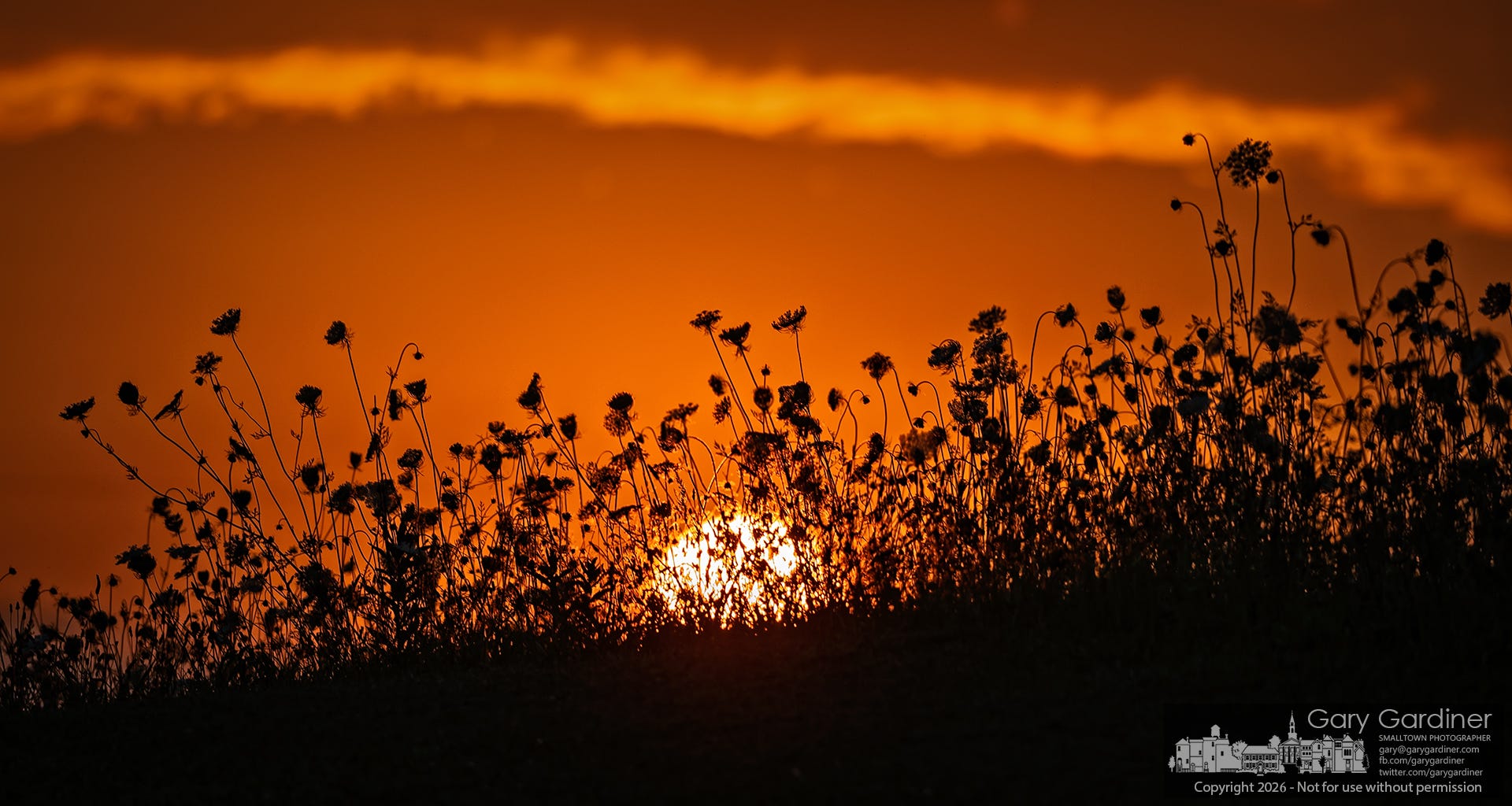
I was taking the familiar route along County Line Road, passing Yarnell’s hayfield I had been watching for some time. Queen Anne’s lace grew along a small rise, its white blossoms scattered through the grass. I had noticed the field before and considered its possibilities, but until that evening, the pieces had never come together.
The revelatory moment came as I passed the small rise in the hayfield. Time slowed. My car seemed to have dropped from forty-five miles an hour to an idle crawl as I watched the orange ball of the sun move ever so slowly along the ridgeline. Stalks of Queen Anne’s lace crossed its face one by one, flashing through my mind as a series of ever-changing silhouettes.
The light stopped me.
I’ve taught myself that slow is fast. Working through an idea, especially an idea for a photograph, is best done at a measured pace, slow enough for the scene to reveal what it holds. As my car eased along the road, my pace seemed to fall into step with time itself. In my slowed vision of the hill, perspective widened and settled into place.
I’ve also learned that it isn’t wise to think too far beyond the first impression of a scene, beyond the photograph I know will happen once I commit to making it. One portion of my mind dealt with the mechanics of moving safely through traffic and making a U-turn on Africa Road. A deeper part was already sorting through cameras and lenses, thinking about exposure and depth of field, and considering how to overcome a pair of legs that had been promised nothing more demanding than cold refreshment and an easy chair.
I parked along the side of a driveway, far enough out of the way for someone to pass but not so far that I intruded on the grass. Before I popped the trunk, I already knew which cameras and lenses I would choose: the full-frame Nikon Z6III with the 70–180mm f/2.8, and the APS-C Z50II with the 300mm f/4. The lenses would work across both bodies, giving me a complementary range of focal lengths suited to the photograph I hoped to make.
Sometimes, as I walk toward a subject, toward the place my mind has selected for the first photograph, I stare at the ground. The photograph in my mind is usually the strongest choice. It doesn’t need a distraction. An ineffective scan of the surroundings can pull me away from that first thought, the most powerful thought for that particular moment.
When I reached my self-assigned shooting position, the scene didn’t look the same. It no longer carried the emphasis it had when I first saw it. Something was off. The angle wasn’t right. The clouds were different. I struggled to find the photograph I had seen from the road.
I quickly understood why. My first impression had come from a car traveling at forty-five miles an hour along County Line Road, not from the adjacent right-of-way. By the time I reached the field, the sun was also lower in the sky. The photograph in my mind had existed for only a moment. It had been created by a moving point of view, a particular angle, and the precise position of the setting sun. Now I had to build another photograph from where I stood.
I searched for the best position, realizing that the next most important photograph would be an insurance photograph, something that would work if the scene suddenly changed. The sun could disappear behind a cloud. The wind could move the flowers. The light could be gone before I solved the problem. I made those safe photographs first. After that set of photos, I began to explore.
This was the moment when my personal mantra subtly appeared: New. Different. Better.
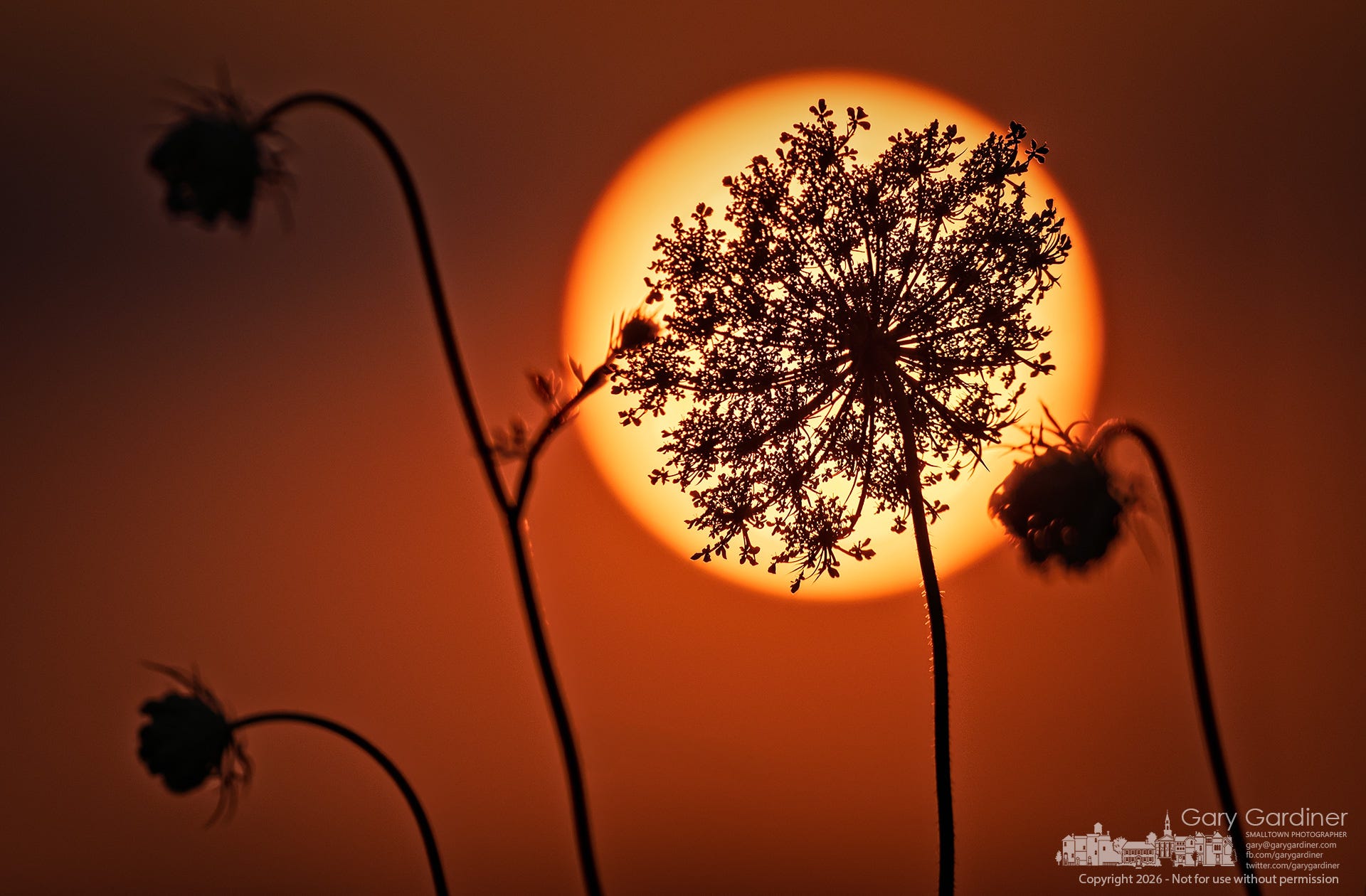
There was nothing new about the basic scene. A setting sun. Foreground objects. Lens choices. It wasn’t an unfamiliar photographic problem. But it was the first time I had seen Queen Anne’s lace silhouetted against the sun. That was the different. Now I had to find the better.
I had photographed Queen Anne’s lace with nearly every camera and lens I own, or have ever owned, even my phone. Some of those photographs were pleasant. Some were very good. These needed to be better.
Better forced me to move through a series of choices, searching for the strongest composition of flowers and sun. The sun was the constant. The variables were the things I couldn’t control: the dynamic way the flowers had grown and blossomed, where they stood, the directions they faced, and how their stems and unopened florets overlapped.
The easy photograph was the general view, a long line of silhouetted flowers arranged like a picket fence across the top of the ridgeline. I photographed it from multiple angles with both cameras and lenses, but none of it looked right. The compositions were too loose. They felt too much like sophisticated snapshots, too much like what any good photographer would have been able to see while standing where I was.
This became the better moment: Get close. Closer than the view from the traffic lane. Close enough for a single Queen Anne’s lace blossom to hold the frame. Close enough to see its fractured symmetry, a shallow bowl of blossoms spread like a delicate crown against the golden sun. A shape and design easily recognized.
That became the next problem looking for a solution. A silhouetted flower photograph was ordinary. The flower could have been any object darkened against the sun: a flock of birds, a treeline, soybeans or corn, traffic, barns, boats, or babies.
The photograph had to be more than unmistakably Queen Anne’s lace. It needed balance. It needed a reference to the flower’s position and its place in the field. Adding the out-of-focus, unopened florets gave the photograph three dimensions. They became objects that kept the eye inside the frame, swirling it around the central subject just as the slight wind tousled the stalks.
The main flower was no longer floating alone against the sun. The surrounding shapes gave it context without competing with it. They suggested the field beyond the frame while allowing the central blossom to remain the reason for the photograph.
I made six different views. Within those views were differences in lens and exposure choices, different positions of the flowers and sun, and differences in solutions. Some frames gave the flower more prominence. Some gave the sun more weight. Others used the surrounding florets to create movement, depth, and balance.
One difference proved stronger than the rest. The best difference became My Final Photo for the day.

My Final Photo News is a reader-supported publication. To receive new posts and support my photography and commentary, become a free or paid subscriber. Subscribe to The Westerville News and PhotoCamp Daily.