
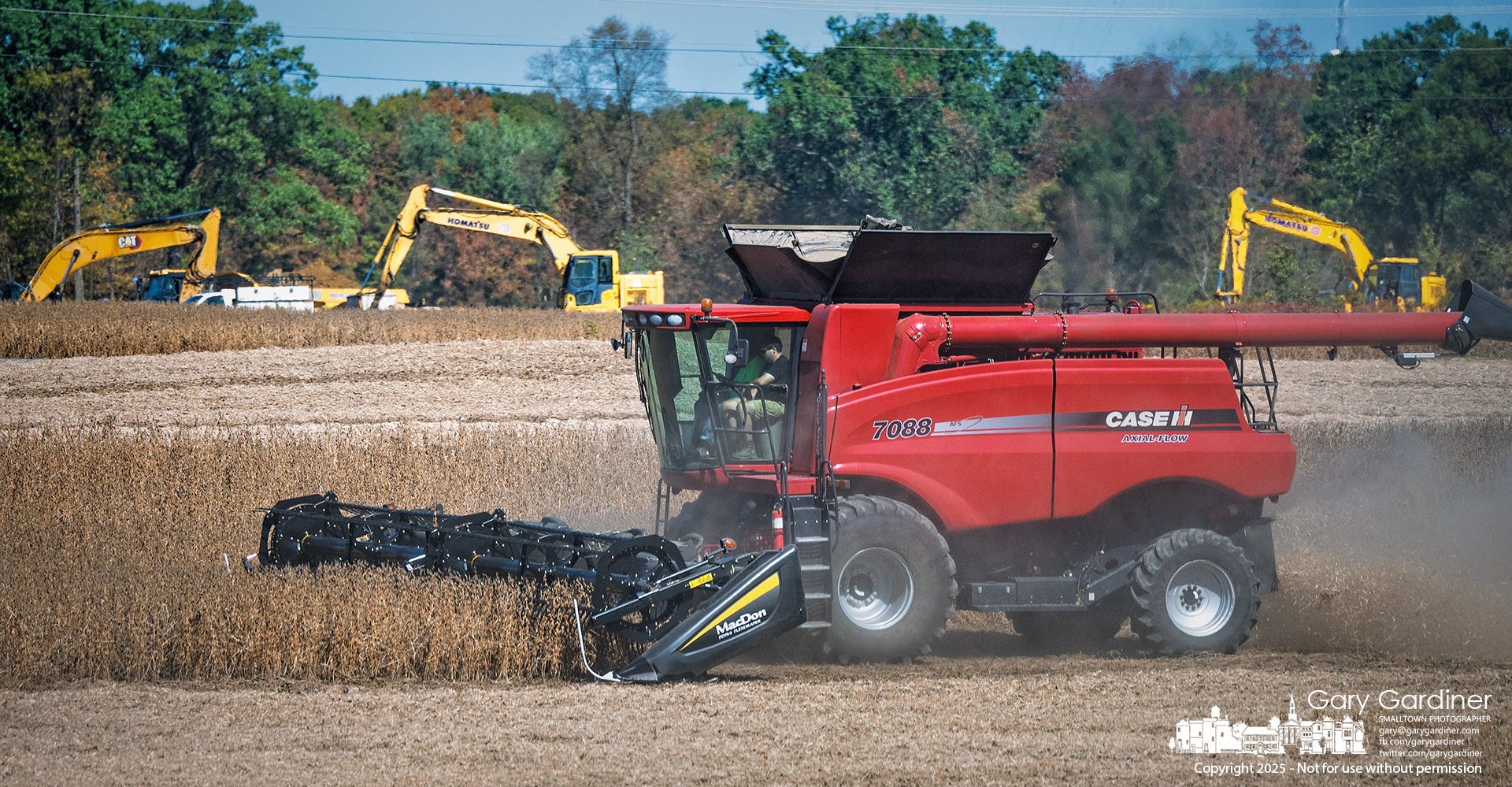
I made this photograph by approaching the scene as a challenge of timing, position, and restraint within real limits. With each pass of the combine, the field shrank, and opportunities dwindled. There was no luxury of prolonged observation. Each cut removed another chance. I watched just enough to grasp the machine's rhythm, then took action. I waited for the combine to move in this direction because it placed the operators in the cab clearly in view and directed the light correctly. The opposite direction would have hidden them. Once those elements lined up, there was no reason to wait any longer.
This photograph exists because the field itself is changing. This was the first harvest on this land since the adjacent 88 acres were sold to the city for business development. What had been open farmland is now being converted into shovel-ready sites for offices, roads, and parking lots.
The soil here is Wisconsinan glacial soil, land that supported generations of farming. That history is ending. The acreage being harvested is the last family-owned parcel within the city limits that is still actively farmed. Even that use has narrowed.
Where this land once produced fruits and vegetables for a local farmers’ market, it now grows soybeans and corn, crops chosen for efficiency rather than community need. Part of that efficiency is agricultural taxation. Row crops allow the land to remain classified as farmland, preserving a lower tax rate even as development encroaches.
That context shaped how I approached the photograph. I was not documenting a routine harvest. I was recording a transition. The machines in the background are not incidental. They signal what is coming next. The combine in the foreground is doing its job, perhaps for one of the last times in this place.
From a technical standpoint, I needed settings that would hold detail in a fast-moving, dusty scene. I shot at f2.8 to keep light intake high while maintaining subject clarity. The shutter speed was set to 1/8000 to freeze the machine and airborne debris while still allowing the dust to retain texture. ISO 250 kept noise down while giving me flexibility in bright daylight.
I used a 180mm focal length to compress the scene and bring distant elements forward without stepping into the field. That compression helped layer the image so the harvest and the development read together rather than as separate events.
Avoid standing too close, but be deliberate about why you are creating distance. In an earlier post titled “Reading a Constrained Scene. A lesson from a street-adjacent setup,” I wrote about using position and focal length to eliminate a distracting car from the background. In that situation, the goal was reduction. Here, the goal was inclusion. I wanted the background interference, because it is not interference at all. It represents what this land is becoming.
I positioned myself on higher ground near the farmhouse so I could see across the field and pull the combine and the construction equipment into the same frame. That vantage point allowed the land to read as one continuous space, from harvest to development. I chose a lens that could take in all of the objects without forcing any single element to dominate.
That elevated position also placed the combine’s hopper and unloading auger directly on the horizon. This alignment matters. The horizon becomes a dividing line between land uses. Below it is the active field, still producing a crop. At it, the machinery intersects with the sky and the distant construction, marking the point where farming gives way to development. When you can align working elements with the horizon like this, it creates a quiet visual cue that reinforces the story without explanation.
Distance compresses the scene and helps organize complexity. The construction equipment becomes context rather than clutter because it is placed intentionally and given visual weight. This serves as a counterpoint to the earlier lesson. Sometimes you use focal length and position to remove distractions. Other times, you use them to make sure nothing important is left out.
Pay attention to light, even when it seems ordinary. Side light reveals texture in the dust, the field, and the metal surfaces. Flat light would have reduced this to a record image instead of a photograph with intent.
Frame with intention and leave space for the subject to move. I allowed room in front of the combine so it feels like it has somewhere to go. Cropping too tight on working machinery removes scale and shortens the story.
When you photograph land like this, look past the immediate action. Ask what the place has been and what it is becoming. Use your framing to include those answers. This is how a photograph moves beyond showing a harvest and begins to document a quiet change, where the crop is no longer food but development waiting in the distance.

My Final Photo News is a reader-supported publication. To receive new posts and support my photography and commentary, become a free or paid subscriber. Subscribe to The Westerville News and PhotoCamp Daily. My Final Photo News also recommends Civic Capacity and Into the Morning by Krista Steele.